
LenecoldA thermal-materials brand of NGIC
Ningbo, China · FOB worldwide
Product · 01 / TIM

Graphene Thermal Pad

A solid, vertically-oriented graphene thermal interface material for high-power electronics. Replaces thermal grease — no pump-out, no dry-out, validated at 150°C for 1,500 hours.
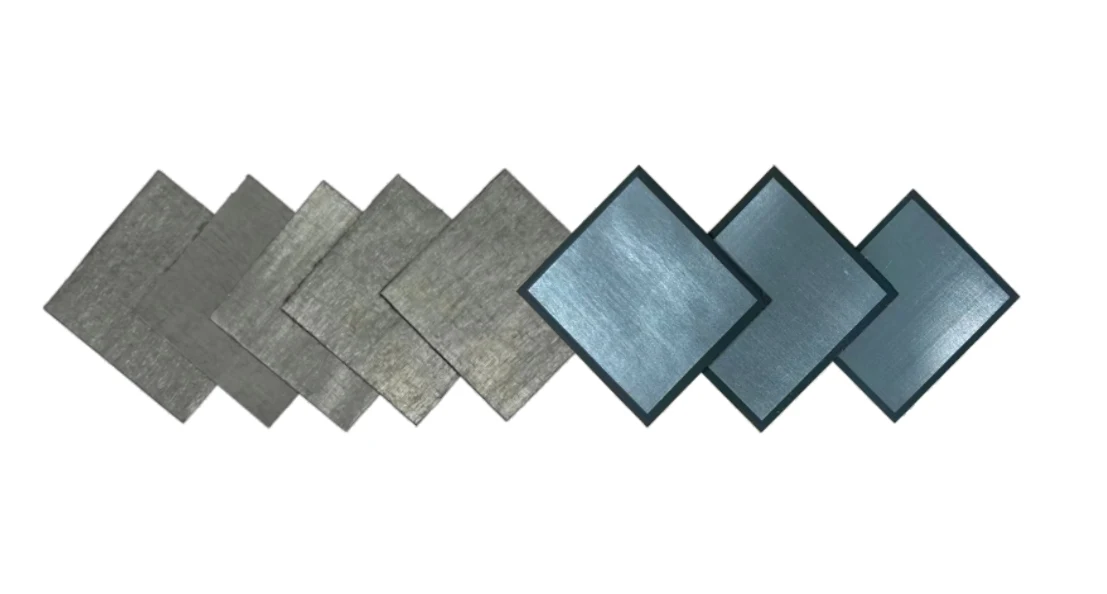
Graphene thermal pads in six standard thicknesses and finishes — flexible, die-cuttable, solid-state thermal interface material for CPUs, GPUs, IGBTs and EV power modules.
Lenecold graphene thermal pad stock — multiple thicknesses, cut to any footprint for your thermal interface.

What it is

Lenecold Thermal Pad is built from vertically-aligned graphene sheets that form a continuous through-thickness heat channel. The pad compresses against the heat source and heat sink under typical mounting pressure (10–50 psi), creating a low-resistance thermal bridge without any liquid interface material.

Where it fits

Use it between any hot silicon and any spreader or cold plate — server CPUs and GPUs, SiP packages, IGBT and SiC power modules, EV traction inverters, on-board chargers, battery management boards, and smart-cockpit domain controllers.

Key specifications

  • 180 W/m·K

    Through-plane thermal conductivity

    Directional graphene structure delivers continuous thickness-direction heat flow. Measurable advantage versus random-orientation TIM.
  • <0.05 °C·cm²/W

    Thermal resistance

    Achieved at low mounting pressure — interface conformable without hardware changes. Tested per ASTM D5470.
  • 150°C × 1500h

    Long-term aging stability

    Thermal resistance drift ≤ 10% and compressibility drift ≤ 10% after 1,500 hours at 150°C / 50 psi — production-validated.
  • 0.3 / 0.5 / 0.7 mm

    Standard thicknesses

    Custom thicknesses and die-cuts available from 0.2 mm to 2.0 mm. Standard sheet size 150 × 150 mm; custom dies on request.
  • Solid

    No pump-out, no dry-out

    Unlike thermal grease, Lenecold pad does not migrate, dry, crack, or contaminate surrounding optics or solder joints.

How it works & what it looks like

Heat is collected at the die, passes through the Lenecold pad's vertically-aligned graphene network, and is spread into the heat sink — a continuous through-thickness thermal path. The SEM cross-section below shows the real microstructure: dense, parallel graphene walls, each one a fast lane for phonon transport.
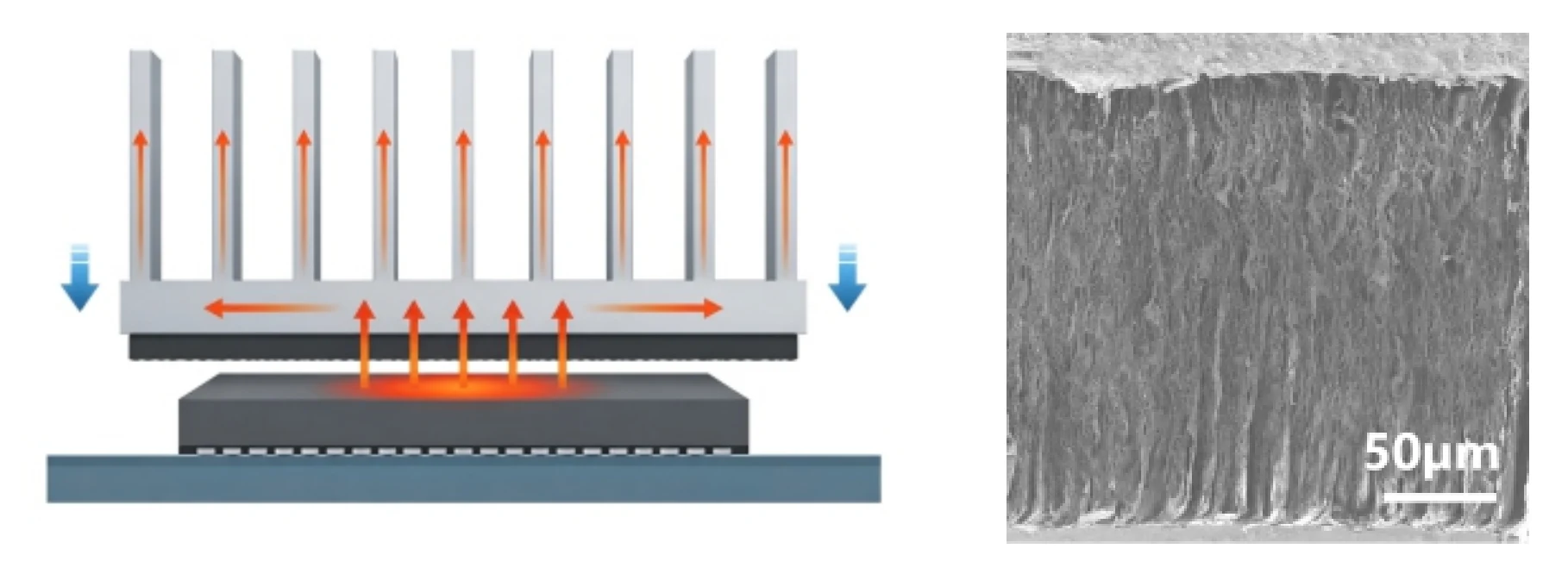
Two-panel evidence: left shows a heat-sink diagram with red arrows depicting heat flowing from chip through Lenecold thermal pad into aluminum fins; right shows an SEM cross-section of vertically-aligned graphene at 50-micrometer scale.
Heat path & microstructure

Left: heat collected at the die, crossing the graphene pad, and spreading into the heat sink. Right: SEM cross-section showing the vertically-aligned graphene walls that form the through-thickness channel — the same microstructure that delivers 180 W/m·K.

A Heat-path diagramB SEM cross-section @ 50 μm

Thermal resistance vs. mounting pressure

Lower is better. Test standard: ASTM D5470.
0.00 0.05 0.10 0.15 0.20 Mounting pressure (psi) Thermal resistance (°C·cm²/W) 10 20 30 40 50 0.7 mm 0.5 mm . 0.3 mm
Result: thinner pads show lower thermal resistance; Lenecold outperforms conventional thermal grease across the full pressure range, with the gap widening at low pressure.

Aging stability — 150°C × 1500 h

Both metrics stay within ±10% of initial value.
≤ 10%
Thermal resistance drift
≤ 10%
Compressibility drift
Test conditions: 150°C ambient, 50 psi sustained load, 1,500 hours continuous. Pass criteria: both metrics ≤ 10% deviation from initial.

Where Lenecold pads deploy

Three verticals that benefit most from solid, ultra-thin, pump-out-free thermal interface material — data center & AI servers, EV mobility, and advanced chip packaging.

Three-application panorama showing Lenecold thermal pad deployed in: data-center server racks (left), an electric-vehicle powertrain (center), and a stacked advanced-package processor module (right).

Ordering info

Standard sheets: 150 × 150 mm. Thickness 0.3 / 0.5 / 0.7 mm in stock. Custom die-cuts, rolls, and adhesive-backed variants available. MOQ for custom: 200 pcs. Lead time for samples: 5 business days. Lead time for production: 2–3 weeks.

Request Quote & Sample →

Engineer a thermal pad spec for your application.

Tell us your heat load (W), footprint (mm), mounting pressure (psi) and ambient range. We'll propose thickness, format, and a sample shipment.

Start a Project →